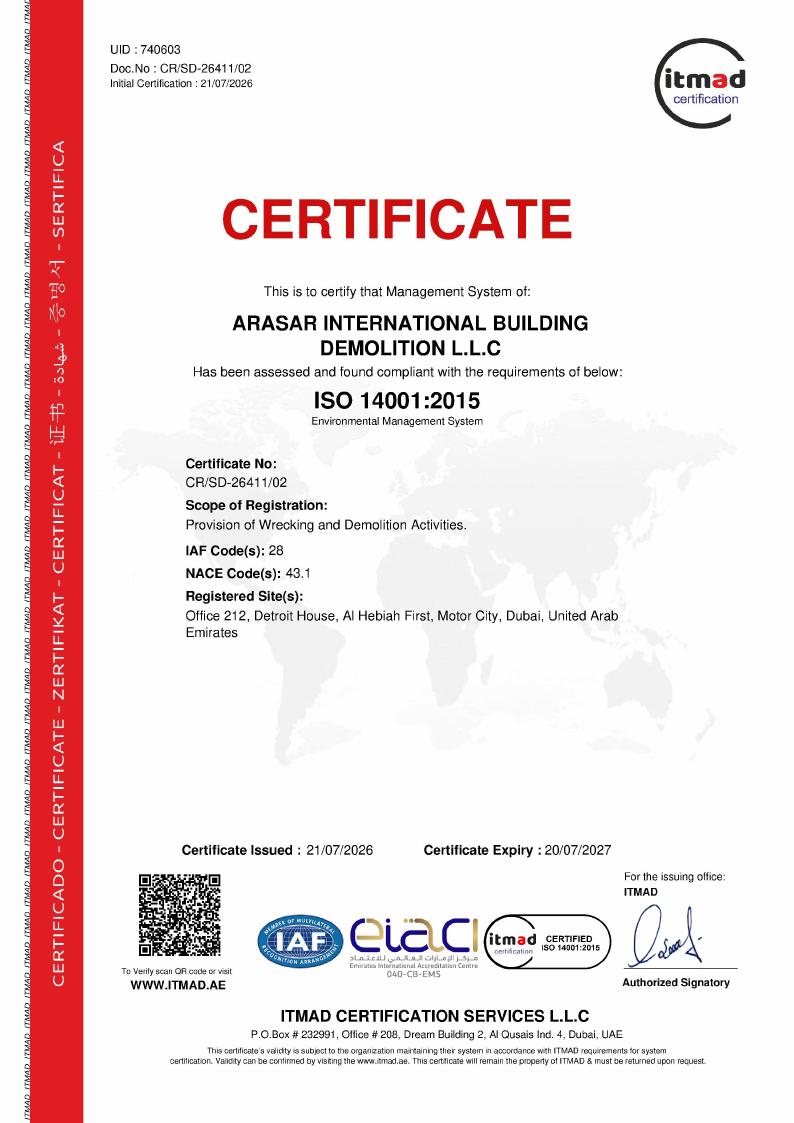
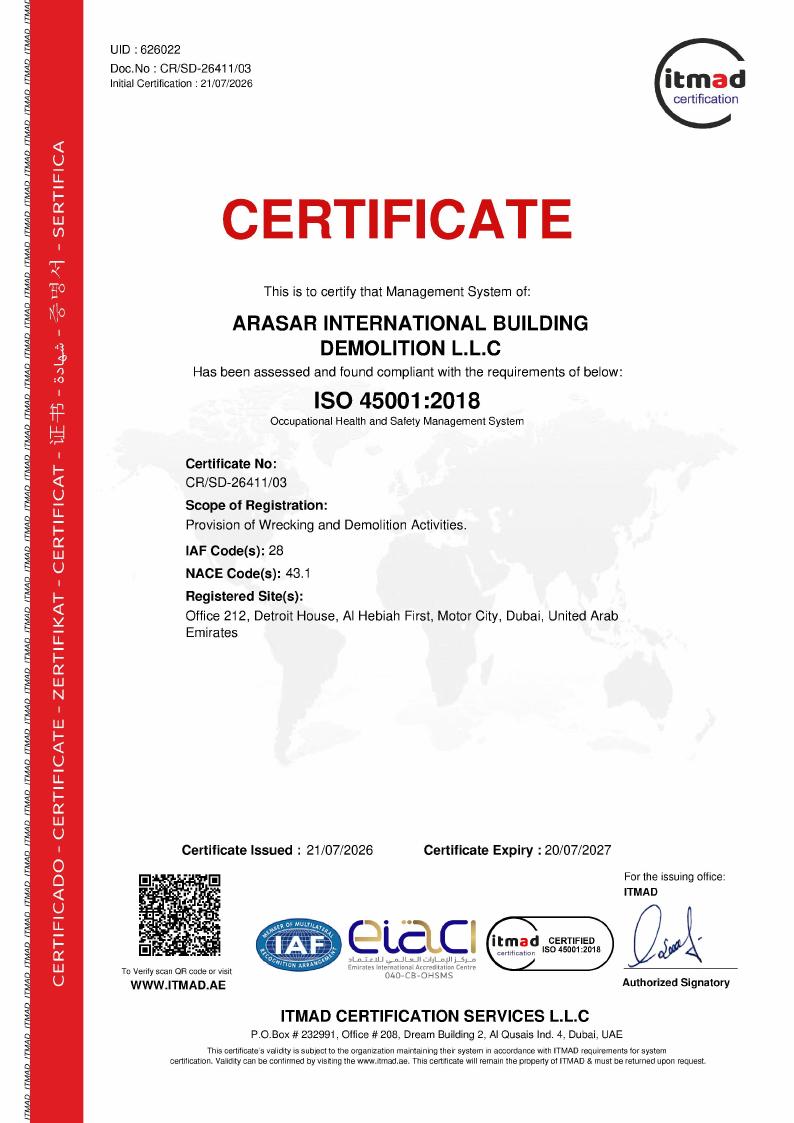
ITMAD and EIAC marks are displayed together, at equal visual weight and without altered proportions, in accordance with the issuer's rules for web use.
Remote laser technology · Dubai
Specialist laser demolition services in Dubai.
Arasar develops laser-based demolition and surface-treatment solutions for specialist work in Dubai and international industrial environments. Remote, non-contact energy can target material where access, contamination or conventional tooling creates unacceptable risk.
Laser systems are not a universal replacement for mechanical demolition. They are a specialist tool for selective ablation, coating and corrosion removal, surface preparation and research-led interventions where precision and remote operation are more important than bulk production.
Every application begins with material testing and an engineered trial. Power, focal distance, extraction, shielding and process speed are validated before the method is scaled. For complex projects, laser technology may be combined with diamond or robotic systems as part of a wider dismantling strategy.
Non-contacttargeted energy without mechanical impact
Typical applications
01Selective surface ablation02Coating and corrosion removal03Hazardous or restricted-access zones04Precision industrial preparation
Why this method
Control at every interface.
Technology creates value only when it is integrated with the structure, the work environment and the required end state.
01
Targeted treatment
Energy can be focused on a defined surface or material layer with no tool contact.
02
Remote potential
Systems can be engineered to increase distance between personnel and the treatment zone.
03
Low mechanical impact
The process avoids the vibration and reaction forces associated with impact tools.
Project workflow
From uncertainty to a controlled sequence.
Each stage produces the information needed to release the next, keeping engineering and site execution aligned.
01
Material assessment
Identify the substrate, target layer, finish requirement and environmental constraints.
02
Trial and validation
Establish workable power, speed, focal parameters, extraction and shielding.
03
Engineered deployment
Configure the delivery system and controls around access and operator separation.
04
Quality verification
Inspect the treated surface and document the achieved result against the trial standard.
Typical deliverables
Clear enough to build from.
Application feasibility review
Material trial record
Laser safety and extraction plan
Surface-quality verification
Technical questions
Before mobilisation.
Final methods and capacities are confirmed after a project-specific site assessment.
01Can laser technology demolish an entire concrete building?+
Laser methods are currently best suited to specialist, selective and surface applications rather than high-volume building removal. Bulk demolition normally uses mechanical, diamond or robotic systems.
02What materials can be treated?+
Suitability depends on the substrate and objective. Concrete surfaces, coatings, corrosion and selected industrial materials may be candidates, but a controlled trial is required.
03Why is a trial necessary?+
Material response, finish, fumes and production rate vary. A trial provides the evidence needed to confirm parameters and decide whether laser treatment is technically and commercially appropriate.











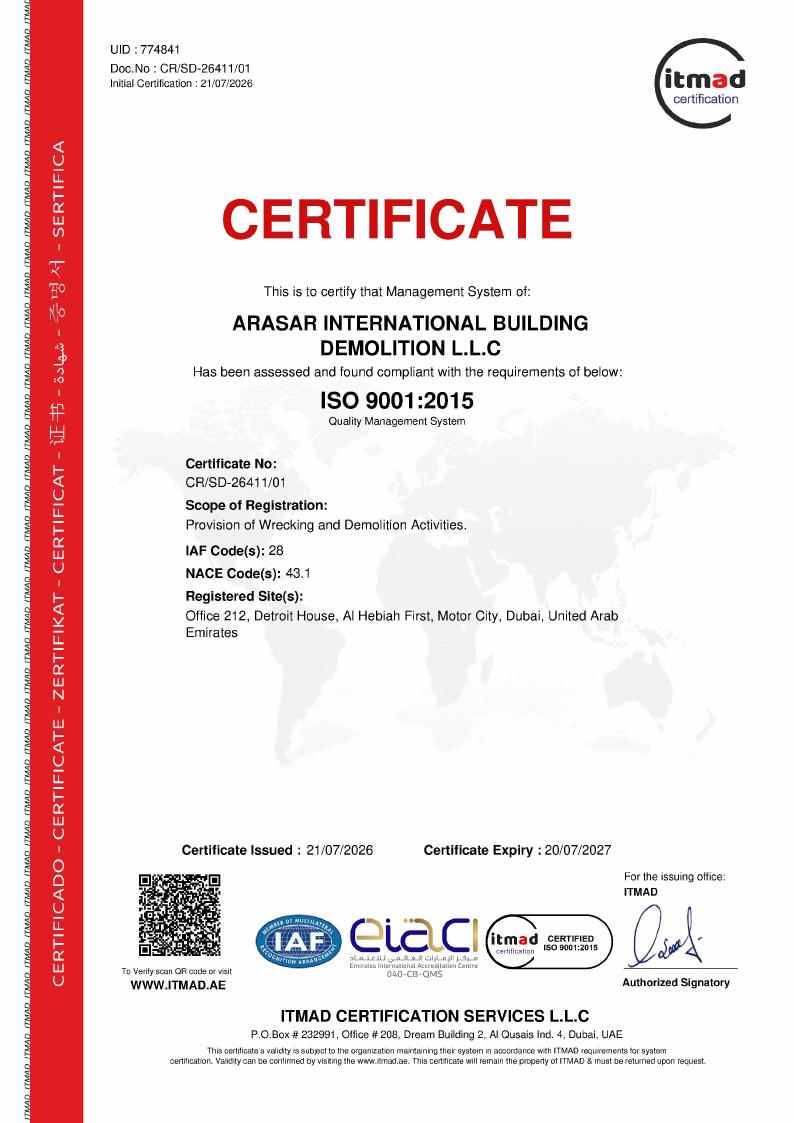 Full certificate