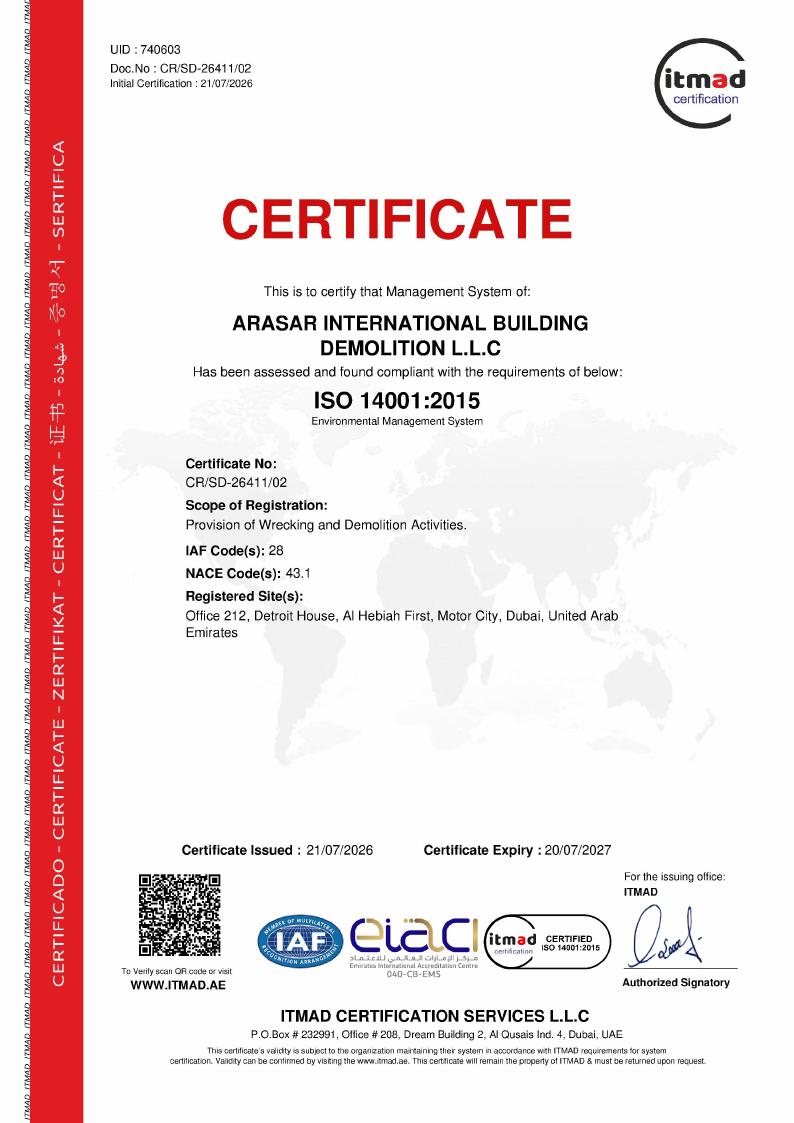
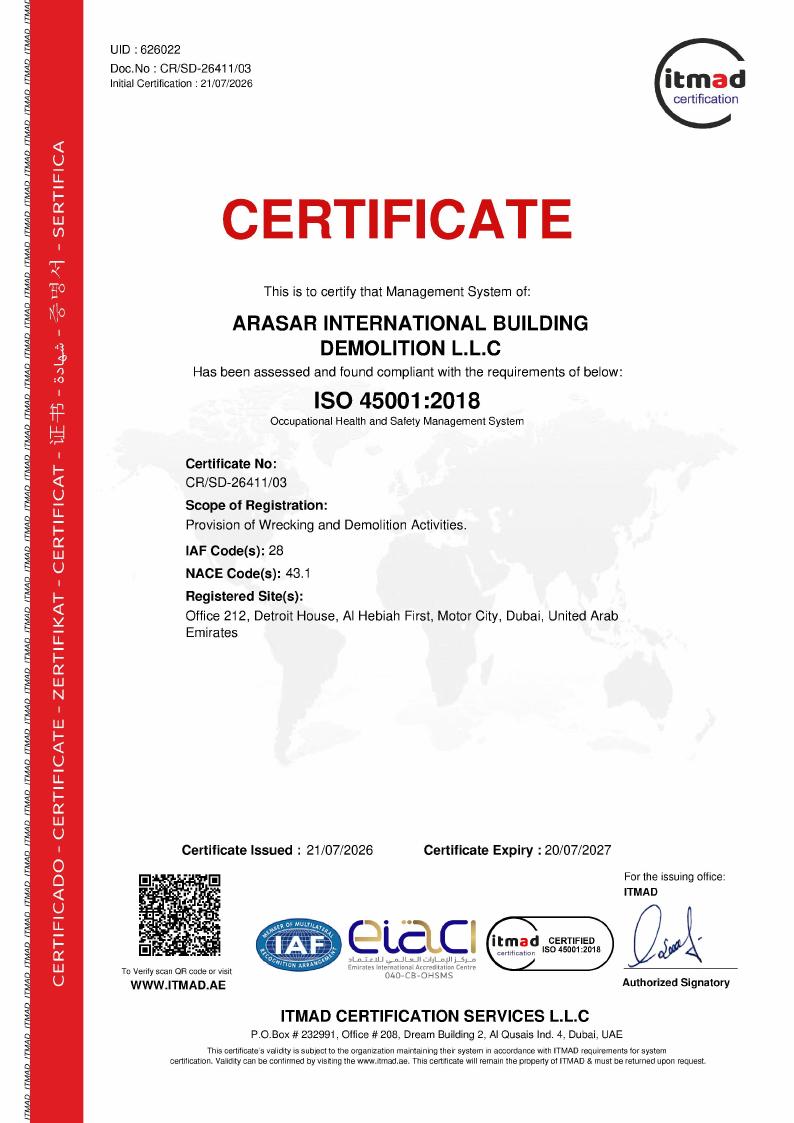
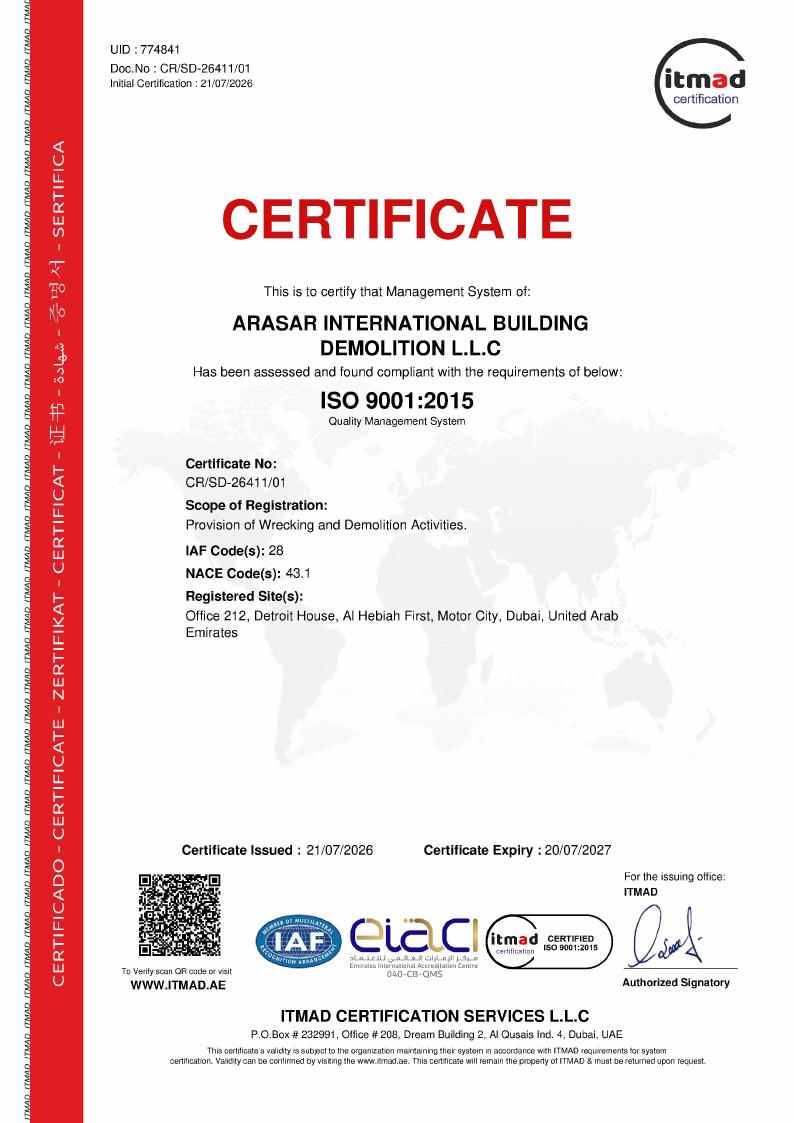
ITMAD and EIAC marks are displayed together, at equal visual weight and without altered proportions, in accordance with the issuer's rules for web use.
Remote-controlled demolition · Dubai & UAE
Robotic demolition and breaking in Dubai and across the UAE.
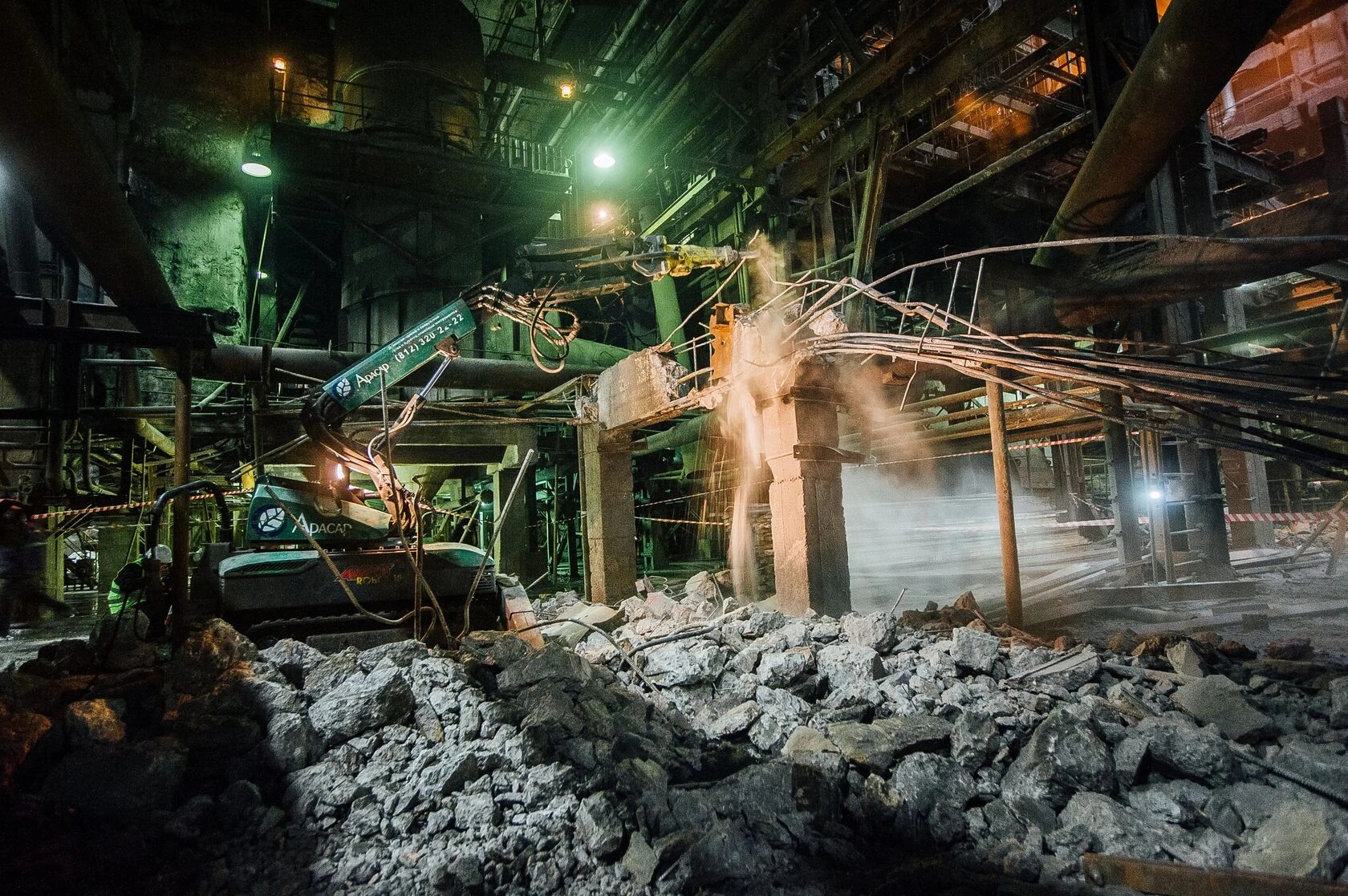
Arasar uses remotely operated demolition robots in Dubai and across the UAE to deliver selective breaking inside confined, live and structurally sensitive environments. Compact machines combine high power with precise control while the operator remains at a safer distance.
Robotic breaking is particularly effective where conventional excavators cannot enter and manual breaking would expose people to unnecessary vibration, falling material or unstable conditions. Electric and compact equipment can work on slabs, walls, refractory material and heavily reinforced sections.
The robot is only one part of the method. Floor loading, access routes, attachments, power, ventilation, debris handling and the structural sequence are engineered before operation. This makes remote demolition a controlled production system rather than an isolated machine solution.
Remoteoperator position outside the immediate hazard
Typical applications
01Confined industrial areas02Selective slab and wall removal03Furnaces and refractory structures04Operational and occupied facilities
Remote-controlled demolition · Dubai & UAE
Remote demolition selected around access, exposure and structure.
Arasar deploys remote-controlled demolition systems from Dubai for suitable confined, sensitive and high-exposure work across the UAE. Machine route, floor loading, attachment, power, exclusion zones and progressive debris removal are engineered around the actual work face.
Operator separation
Remote control moves the operator away from the immediate breaking and falling-material zone while supervision and exclusions remain in force.
Compact access
Machine dimensions, route, slopes, floor capacity and working radius are checked before a robotic system is selected.
Attachment-led production
Breakers, crushers and specialist tools are matched to the material, structural sequence and required debris size.
Technology creates value only when it is integrated with the structure, the work environment and the required end state.
01
Reduced exposure
The operator controls the machine away from the immediate breaking and falling-material zone.
02
Compact access
Small tracked platforms can reach areas that are unsuitable for conventional excavators.
03
Attachment flexibility
Breakers, crushers and specialist tools are selected around the material and structural objective.
Project workflow
From uncertainty to a controlled sequence.
Each stage produces the information needed to release the next, keeping engineering and site execution aligned.
01
Access assessment
Verify routes, openings, floor capacity, working radius and debris flow.
02
Attachment selection
Match breaker, crusher or specialist tool to the material and required production rate.
03
Controlled operation
Work through the engineered sequence with exclusion zones and continuous supervision.
04
Debris management
Remove broken material progressively to maintain safe access and floor loading.
Typical deliverables
Clear enough to build from.
Access and floor-loading review
Robotic demolition sequence
Attachment and power plan
Debris handling strategy
Your project enquiry
Check whether robotic demolition fits your site.
Remote operation can help with constrained demolition, but the machine must suit the access, structure and work area. Send the site information for a suitability review.
What to send
Photographs, removal scope and material to be broken
Access widths, headroom, floor level and available structural information
Occupied areas, operating restrictions and available power
Debris route, handling requirements and target programme
What affects the price
Robot and attachment selection, access, setup, concrete conditions and debris handling affect cost and output. A quotation follows the project review, not a universal daily production promise.
What to agree in the scope
Confirm machine access, floor loading, operator separation, attachment requirements and the removal package. The fleet page introduces the equipment; this service page covers planning and execution.
Final methods and capacities are confirmed after a project-specific site assessment.
01Where is robotic demolition most useful?+
It is valuable in confined areas, live facilities, upper floors and high-risk zones where compact access and remote operation improve control.
02Does a demolition robot eliminate all manual work?+
No. Skilled personnel are still required for setup, supervision, support activities and material handling. The robot reduces direct exposure during the most demanding breaking operations.
03Can a robot work on an upper floor?+
Potentially, but the structure, access path, point loads and debris loads must be assessed first. Temporary load distribution or alternative equipment may be required.















 Full certificate