



















Choose wire sawing for thickness and complex geometry
A diamond wire is routed around or through the concrete using a drive and pulley system. Because the cut is not limited by the diameter of a circular blade, wire saw cutting is well suited to thick foundations, pile caps, beams, columns, bridge elements and irregular mass-concrete sections.
Wire routes can be configured around restricted access, but that flexibility does not remove the need for engineering. Pulley positions, guarding, water control, temporary support, section weights and lifting points must be developed before the final release cut.
- Thick or heavily reinforced concrete
- Foundations, pile caps and mass-concrete sections
- Irregular shapes or restricted circular-blade access
- Large sections prepared for controlled lifting
Choose wall sawing for straight structural openings
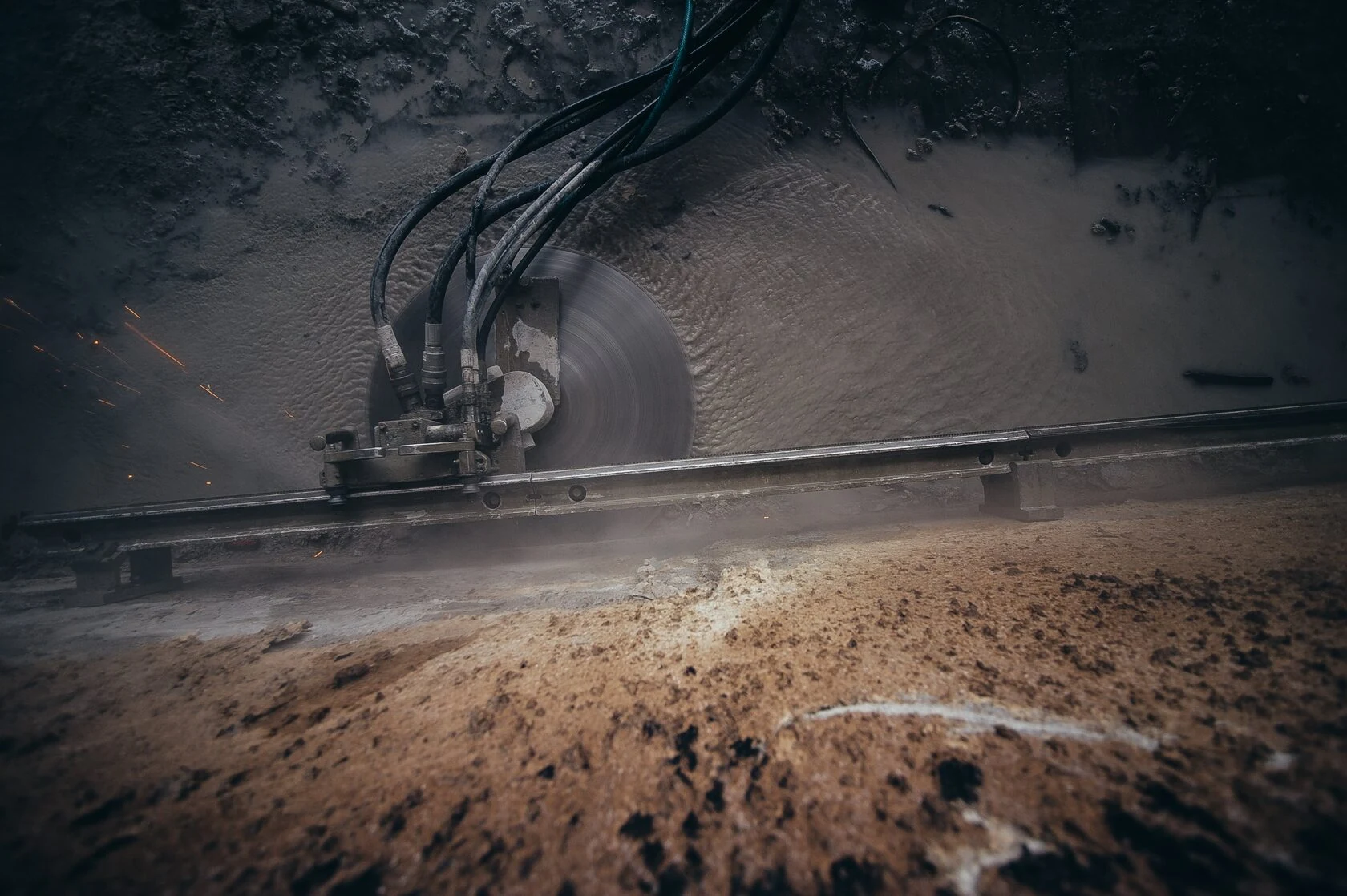
A wall saw runs on a rigid track fixed to the concrete. The track guides a diamond blade along a defined line, making the method effective for doors, windows, lift and stair shafts, service openings and linear separation in walls or slabs.
Wall saw cutting is selected for its accurate edges and predictable geometry. The opening still needs a removal plan: cut intersections, temporary support and individual section sizes should be coordinated so no piece becomes unstable as the final line is completed.
- Door, window and structural wall openings
- Lift, stair and building-services shafts
- Straight vertical, horizontal or inclined cuts
- Alterations where retained edges and finishes matter
Both methods depend on the same engineering controls
The saw type does not determine structural safety by itself. Drawings, scanning information and site verification must be reviewed for reinforcement, post-tension cables, utilities and previous alterations. Load paths and temporary support are especially important when cutting a load-bearing wall, beam, slab or foundation.
Dubai and UAE projects may also require tight control of water, slurry, access, noise, work hours and material movement. In live buildings or industrial facilities, these interfaces can shape the method more than the cutting speed.
- Structural review and verified set-out
- Concrete scanning where concealed hazards may be present
- Temporary support, lifting and exclusion zones
- Water recovery, slurry handling and retained-area protection
Complex UAE projects often combine wire and wall saws
A single alteration can require track-mounted wall sawing for the main opening, diamond wire sawing through a thick boundary element and floor sawing or core drilling for the remaining geometry. Selecting one system too early can create unnecessary setup, overcutting or difficult section handling.
The reliable approach is to define the final opening and removal sequence first, then assign the cutting technology to each plane. Arasar develops the method around the retained structure, access and project operations before equipment is mobilised in Dubai or elsewhere in the UAE.
Project note
Guidance is the starting point. The site determines the method.
Every structure, access route and operating environment is different. Final engineering, approvals and controls should be based on verified project information and a site-specific assessment.